Latest News
Police officers 'smashed OAP driver's window and dragged him out of car' after he was stopped for not wearing seatbelt
By Daily Mail Reporter
Two policemen were suspended after a disabled pensioner claimed he was left terrified by officers who smashed his car window after catching him driving without a seatbelt.
When stroke victim Robert Whatley, 70, was pulled over in his Range Rover, he expected a brief discussion with the officers.
But he claims he was forced to cover his face and was showered with glass as one officer jumped on to the bonnet and kicked his windscreen while another repeatedly attacked the window with a baton.
The ensuing action was caught on film by a police camera placed on the patrol car's dashboard.
 Caught on camera: Two police officers were suspended after a pensioner was left terrified by police who smashed in his car windows after catching him driving without a seatbelt. The episode was captured on a police video
 The police video, released by Mr Whatley's solicitor, shows an officer taking a run up with a telescopic 'Asp' baton
The police video, released by Mr Whatley's solicitor, shows an officer taking a run up with a telescopic 'Asp' baton.
It also apparently captures the officer hitting the side window 15 times before it smashes and shows a policeman climbing onto the bonnet before Mr Whatley is dragged out of his car.
Retired businessman Mr Whatley said: 'I couldn't believe what was happening.
'The police went completely over the top - you would have thought I had robbed a bank.
'I was terrified when they started smashing in the window and trying to kick in the windscreen. I tried to shield myself but I was showered with glass which could easily have gone into my eyes.
 Disabled driver Robert Whatley, 70, who was pulled from his car after having the windscreen smashed and kicked in by Gwent police
 Police force: One of the officers leapt on to the bonnet of Mr Whatley's Range Rover and attempted to kick in his windscreen
'It's something you might expect in America but not in the quiet of the British countryside.'
The elderly man, who has a heart condition, was initially pulled over for not wearing a seat belt as he drove through the country lanes of South Wales.
Officers tried to issue him with a fixed penalty notice but Mr Whatley drove off.
Two Gwent police officers followed him along eight miles of country lanes for 17 minutes before trying to stop the £60,000 Range Rover with a stinger device.
But Mr Whatley pulled over again and waited for them to approach.
He was later charged with a series of motoring offences.
At Caerphilly Magistrates Court he admitted not wearing his seatbelt when he was first stopped by police but claimed he had been reversing at the time.
The court heard that as the officer went round to the passenger side, the car lurched forward and the officer was knocked - a claim disputed by Mr Whatley.
 The video shows a policeman climbing onto the bonnet before Mr Whatley is dragged out of his car
 One policeman climbs onto the bonnet. Two officers had been removed from operational duty
He told the court he then drove off because he thought he had been dealt with, was 'frail and vulnerable' and worried he would suffer another stroke.
'I feel on health grounds I was justified,' he said. 'I was displaying my medication needs and the officer was ignoring me.
'My survival instinct was such was that I was trying to assist the officer the best I could. I feared another stroke.
'I thought he had finished with me. I just drove off coolly and calmly and not off at speed.'
Mr Whatley, who never broke the speed limit during the chase, said he had become confused during the pursuit.
He said he thought that the blue lights and siren of the pursuing car meant the officer was giving him a police escort home.
But he finally pulled over when he was confronted by a police 'stinger' device on the road into Usk.
He was found guilty of not wearing a seatbelt, failing to stop for a police officer and having tinted car windows which did not conform to legal requirements but cleared of failing to stop after an accident. He also admitted having a registration plate which did not adhere to regulations.
The pensioner was fined a total of £235 and ordered to pay £300 towards prosecution costs.
Mr Whatley has complained to Gwent Police and the the Independent Police Complaints Commission (IPCC) which has now launched an investigation into the incident.
Gwent Police said yesterday that two officers had been removed from operational duty.
Deputy Chief Constable Carmel Napier said: 'When the incident happened Gwent Police had great concerns about what appeared to have occurred.
'Immediate contact was made with the complainant, his concerns recorded and a voluntary referral made by the force to the IPCC.
'We expect the highest professional standards of its police officers and staff at all times and we can assure Mr Whatley and the public that this matter will be thoroughly investigated.'
By Daily Mail Reporter
Two policemen were suspended after a disabled pensioner claimed he was left terrified by officers who smashed his car window after catching him driving without a seatbelt.
When stroke victim Robert Whatley, 70, was pulled over in his Range Rover, he expected a brief discussion with the officers.
But he claims he was forced to cover his face and was showered with glass as one officer jumped on to the bonnet and kicked his windscreen while another repeatedly attacked the window with a baton.
The ensuing action was caught on film by a police camera placed on the patrol car's dashboard.


The police video, released by Mr Whatley's solicitor, shows an officer taking a run up with a telescopic 'Asp' baton.
It also apparently captures the officer hitting the side window 15 times before it smashes and shows a policeman climbing onto the bonnet before Mr Whatley is dragged out of his car.
Retired businessman Mr Whatley said: 'I couldn't believe what was happening.
'The police went completely over the top - you would have thought I had robbed a bank.
'I was terrified when they started smashing in the window and trying to kick in the windscreen. I tried to shield myself but I was showered with glass which could easily have gone into my eyes.


'It's something you might expect in America but not in the quiet of the British countryside.'
The elderly man, who has a heart condition, was initially pulled over for not wearing a seat belt as he drove through the country lanes of South Wales.
Officers tried to issue him with a fixed penalty notice but Mr Whatley drove off.
Two Gwent police officers followed him along eight miles of country lanes for 17 minutes before trying to stop the £60,000 Range Rover with a stinger device.
But Mr Whatley pulled over again and waited for them to approach.
He was later charged with a series of motoring offences.
At Caerphilly Magistrates Court he admitted not wearing his seatbelt when he was first stopped by police but claimed he had been reversing at the time.
The court heard that as the officer went round to the passenger side, the car lurched forward and the officer was knocked - a claim disputed by Mr Whatley.


He told the court he then drove off because he thought he had been dealt with, was 'frail and vulnerable' and worried he would suffer another stroke.
'I feel on health grounds I was justified,' he said. 'I was displaying my medication needs and the officer was ignoring me.
'My survival instinct was such was that I was trying to assist the officer the best I could. I feared another stroke.
'I thought he had finished with me. I just drove off coolly and calmly and not off at speed.'
Mr Whatley, who never broke the speed limit during the chase, said he had become confused during the pursuit.
He said he thought that the blue lights and siren of the pursuing car meant the officer was giving him a police escort home.
But he finally pulled over when he was confronted by a police 'stinger' device on the road into Usk.
He was found guilty of not wearing a seatbelt, failing to stop for a police officer and having tinted car windows which did not conform to legal requirements but cleared of failing to stop after an accident. He also admitted having a registration plate which did not adhere to regulations.
The pensioner was fined a total of £235 and ordered to pay £300 towards prosecution costs.
Mr Whatley has complained to Gwent Police and the the Independent Police Complaints Commission (IPCC) which has now launched an investigation into the incident.
Gwent Police said yesterday that two officers had been removed from operational duty.
Deputy Chief Constable Carmel Napier said: 'When the incident happened Gwent Police had great concerns about what appeared to have occurred.
'Immediate contact was made with the complainant, his concerns recorded and a voluntary referral made by the force to the IPCC.
'We expect the highest professional standards of its police officers and staff at all times and we can assure Mr Whatley and the public that this matter will be thoroughly investigated.'
Swizz and Alicia's Ties the knot in style
 ShareThis I guess this is wedding season, this week we have seen T.I., Jazzy Jeff, and now Swizz Beatz all marry their beautiful women. Swizz and Alicia had there ceremony in Italy and here are some photos. Congratulations


It's official: Bill and Hillary Clinton 'so happy' as they see their daughter Chelsea marry in front of 500 guests
By Laura Collins
Chelsea Clinton has finally become a married woman, saying her vows in an idyllic gazebo decked with white roses under the late afternoon summer sun.
The groom was ‘a bundle of nerves’ and the father of the bride ‘so emotional’ he considered just getting his daughter down the aisle was ‘a major accomplishment’. As for the bride, she had, she told friends jokingly, rather hoped for a small wedding.
But it’s hard to be low-key when your big day is hailed as America’s ‘Royal wedding’, and last-minute preparations include shutting down a chunk of federal airspace, with the secret service making sure access roads to the venue are secure.
 Idyllic setting: Chelsea Clinton and new husband Marc Mezvinsky pose for photographs after getting married yesterday at Astor Courts, in New York state
 Proud father: Bill Clinton leads his daughter down the aisle in front of 500 guests who had gathered in Rhinebeck for the occasion
 Happy family: (left to right) Marc Mezvinsky with Hillary Clinton, his bride Chelsea and father-in-law Bill Clinton after the couple's wedding
Chelsea, 30, married childhood friend, financier Marc Mezvinsky, 32, in a ceremony that took place at 5pm local time in Astor Courts, the former home of millionaire businessman John Jacob Astor IV, set in 50 acres of land overlooking the Hudson River in Rhinebeck, New York state.
Shortly afterwards her proud parents released a statement saying: 'Today, we watched with great pride and overwhelming emotion as Chelsea and Marc wed in a beautiful ceremony at Astor Courts, surrounded by family and their close friends.
'We could not have asked for a more perfect day to celebrate the beginning of their life together, and we are so happy to welcome Marc into our family. On behalf of the newlyweds, we want to give special thanks to the people of Rhinebeck for welcoming us and to everyone for their well-wishes on this special day.
 'Flower bower: The couple had an interdenominational service as Marc is Jewish and Chelsea is a practising Methodist

Perfect day: Chelsea and Marc's big day is said to have cost around £3.2million while her Vera Wang dress came in at around £20,000
When it came down to it, the ‘hoopla’, as Chelsea described it, that comes with being the daughter of Bill and Hillary Clinton, was worth it.
President Obama had reportedly offered the White House as a venue, while actor Ted Danson, a family friend, suggested his home on Martha’s Vineyard. But the couple opted for a small town 90 miles north of Manhattan and the relative seclusion of the Astor estate.
More...A quiet wedding Chelsea? Dream on! With 500 guests and a £3.2m bill, that was NEVER going to happen
Decked in white roses, the beautiful setting where Chelsea Clinton is saying her wedding vows
Residents inconvenienced by the circus surrounding the wedding were given a bottle of wine from Clinton Vineyards – coincidentally the name of the wine producer that neighbours the Astor estate.
The bottle came with a handwritten note of apology from the couple’s wedding planner and offered a telephone number to call if there were any problems.
 The congregation: Friends and family of Chelsea Clinton and Marc Mezvinsky, some with white parasols to shade them from the afternoon sun, gather in front of the white rose-decked gazebo where the couple said their wedding vows
 Sweet music: A small chamber orchestra can be seen to the left of the gazebo where Chelsea got married yesterday
 Like clockwork: Buses at the front of the Astor estate, which ferried the guests to the ceremony in the gardens to the back of the building
The night before, wellwishers lined the streets of Rhinebeck as the wedding party enjoyed a rehearsal dinner at the local Beekman Arms Inn. But though they smiled and waved, Chelsea and Marc’s parents were silent about the details of yesterday’s ceremony, which is estimated to have cost £3.2million.
With a guest list of 500, it could hardly be described as intimate but, according to one source, ‘Chelsea actually has a very small circle of friends.
Of course she understood that, her parents being who they are, she didn’t have much choice but to have a big do.
 Glammed up: A wedding guest makes her way through to one of the buses in Rhinebeck which was ferrying the exclusive congregation to Chelsea's wedding
 Glittering: Guests wait for a bus to depart from the Delamater Inn to go to the wedding
So her one stipulation was that she and Marc had to have at least met everybody who was invited.’
Who received an invitation has been the subject of much speculation, but Steven Spielberg, producer Steve Bing, Barbra Streisand and Oprah Winfrey were expected to attend.
Tony Blair was believed to have been invited, but was unable to go.
Chelsea has been a vegan for more than ten years and instructed society caterer Olivier Cheng to provide vegetarian and vegan dishes for the wedding feast.
Her £7,000, five-tier wedding cake was gluten-free. But the meat-eaters among her guests would have been relieved to see that organic beef was also on the menu.
 Protection: A team of security patrol the Rhinebeck streets ahead of the ceremony which took place at 5pm
 Line up: Limousines wait outside a hotel in Rhinebeck before yesterday's service
The scale of the wedding has been made clear by the small army of workmen employed over the past week to construct pavilions and marquees at a cost of £400,000.
Tables and crockery are believed to have added another £75,000 to the bill.
But though Chelsea’s dress – thought to be designed by Vera Wang – reportedly cost between £16,000 and £20,000 and she was expected to wear £160,000 worth of jewellery (as well as her £600,000 engagement ring), her own style, according to one friend, is, ‘low-key and modest’.
She is currently studying for a masters degree at Columbia University’s School of Public Health.
And though she may be a far cry from the awkward, curly-haired 12-year-old who stood with her parents on the steps of the White House in 1992 when Bill was first elected President, Chelsea has no desire to follow her parents – mum Hillary is the US Secretary of State – into public office.
The couple met as teenagers and their friendship gradually turned into romance. According to a friend of the couple: ‘Chelsea adores Marc and her parents do, too’.
 It's all for our girl: Former U.S. president Bill Clinton and his wife, U.S. Secretary of State Hillary arrive for the rehearsal dinner at the Beekman Arms Inn in Rhinebeck, New York
By Laura Collins
Chelsea Clinton has finally become a married woman, saying her vows in an idyllic gazebo decked with white roses under the late afternoon summer sun.
The groom was ‘a bundle of nerves’ and the father of the bride ‘so emotional’ he considered just getting his daughter down the aisle was ‘a major accomplishment’. As for the bride, she had, she told friends jokingly, rather hoped for a small wedding.
But it’s hard to be low-key when your big day is hailed as America’s ‘Royal wedding’, and last-minute preparations include shutting down a chunk of federal airspace, with the secret service making sure access roads to the venue are secure.


Chelsea, 30, married childhood friend, financier Marc Mezvinsky, 32, in a ceremony that took place at 5pm local time in Astor Courts, the former home of millionaire businessman John Jacob Astor IV, set in 50 acres of land overlooking the Hudson River in Rhinebeck, New York state.
Shortly afterwards her proud parents released a statement saying: 'Today, we watched with great pride and overwhelming emotion as Chelsea and Marc wed in a beautiful ceremony at Astor Courts, surrounded by family and their close friends.
'We could not have asked for a more perfect day to celebrate the beginning of their life together, and we are so happy to welcome Marc into our family. On behalf of the newlyweds, we want to give special thanks to the people of Rhinebeck for welcoming us and to everyone for their well-wishes on this special day.


Perfect day: Chelsea and Marc's big day is said to have cost around £3.2million while her Vera Wang dress came in at around £20,000
When it came down to it, the ‘hoopla’, as Chelsea described it, that comes with being the daughter of Bill and Hillary Clinton, was worth it.
President Obama had reportedly offered the White House as a venue, while actor Ted Danson, a family friend, suggested his home on Martha’s Vineyard. But the couple opted for a small town 90 miles north of Manhattan and the relative seclusion of the Astor estate.
More...A quiet wedding Chelsea? Dream on! With 500 guests and a £3.2m bill, that was NEVER going to happen
Decked in white roses, the beautiful setting where Chelsea Clinton is saying her wedding vows
Residents inconvenienced by the circus surrounding the wedding were given a bottle of wine from Clinton Vineyards – coincidentally the name of the wine producer that neighbours the Astor estate.
The bottle came with a handwritten note of apology from the couple’s wedding planner and offered a telephone number to call if there were any problems.


The night before, wellwishers lined the streets of Rhinebeck as the wedding party enjoyed a rehearsal dinner at the local Beekman Arms Inn. But though they smiled and waved, Chelsea and Marc’s parents were silent about the details of yesterday’s ceremony, which is estimated to have cost £3.2million.
With a guest list of 500, it could hardly be described as intimate but, according to one source, ‘Chelsea actually has a very small circle of friends.
Of course she understood that, her parents being who they are, she didn’t have much choice but to have a big do.


So her one stipulation was that she and Marc had to have at least met everybody who was invited.’
Who received an invitation has been the subject of much speculation, but Steven Spielberg, producer Steve Bing, Barbra Streisand and Oprah Winfrey were expected to attend.
Tony Blair was believed to have been invited, but was unable to go.
Chelsea has been a vegan for more than ten years and instructed society caterer Olivier Cheng to provide vegetarian and vegan dishes for the wedding feast.
Her £7,000, five-tier wedding cake was gluten-free. But the meat-eaters among her guests would have been relieved to see that organic beef was also on the menu.


The scale of the wedding has been made clear by the small army of workmen employed over the past week to construct pavilions and marquees at a cost of £400,000.
Tables and crockery are believed to have added another £75,000 to the bill.
But though Chelsea’s dress – thought to be designed by Vera Wang – reportedly cost between £16,000 and £20,000 and she was expected to wear £160,000 worth of jewellery (as well as her £600,000 engagement ring), her own style, according to one friend, is, ‘low-key and modest’.
She is currently studying for a masters degree at Columbia University’s School of Public Health.
And though she may be a far cry from the awkward, curly-haired 12-year-old who stood with her parents on the steps of the White House in 1992 when Bill was first elected President, Chelsea has no desire to follow her parents – mum Hillary is the US Secretary of State – into public office.
The couple met as teenagers and their friendship gradually turned into romance. According to a friend of the couple: ‘Chelsea adores Marc and her parents do, too’.

A dam big project: Incredible images of construction work on 1,900ft-long Hoover Bridge
It is one of the planet's newest awe-inspiring superstructures - the Hoover Dam Bridge.
Now the giant construction project which is on schedule to be completed in September can be seen in all its glory in a series of stunning photographs.
Twelve years in planning and five years under construction, the development - known officially as the 'Mike O'Callaghan-Pat Tillman Memorial Bridge' - is finally taking shape.
 Spectacular structure: The Hoover Dam Bridge rises from the river banks in the middle stages of the £160m project
Rising 890 ft above the Colorado River, when finished, its total length will be 1,900 ft, with its longest supported span running to 1080 ft.
Built in the shadow of the iconic Hoover Dam, which powers most of states Nevada and Arizona, the construction is the first concrete-steel composite arch bridge built in the United States.
With costs estimated to run to £160 million, the bridge is designed to take the pressure off the congested US Highway 93 and is expected to carry 17,000 trucks and cars daily.
It will also allow the roadway that runs on top of the Hoover Dam to close.
Having long been the most accessible river crossing between Nevada and Arizona, the dam is thought to be at risk of a terror strike, with trucks already banned from crossing.
In November, cars will no longer be able to cross the dam which was built in 1936.
 Don't look down: Workers use a crane to construct the top of the bridge's arch during the large-scale project
 Let there be light: Night time work on the Hoover Bridge continues unabated thanks to huge lighting towers
Designed by T.Y Lin International, the bridge will be four lanes wide and is designed to match the style of the dam shadowing it, which holds back artificial Lake Mead.
Around 3,000 workers have helped construct the bridge using 2,300 feet long steel cables held aloft by a 'high line' crane system.
The distinctive arches are made up of 106 concrete and steel arches, each one 24ft-long.
The bridge is due is named after Mike O'Callaghan, a former Nevada Governor and Pat Tillman a former All Star American Football player who left his lucrative career and enlisted in the army after 9/11.
He was killed in a friendly fire incident in Afghanistan.
Documenting the last 18 months on camera has been Santa Fe resident Jamey Stillings, 38.
 Patriotic: A U.S. flag can be seen flying on the Mike O'Callaghan-Pat Tillman Memorial Bridge which is partly named after American football star Tillman who was killed serving in Afghanistan
'I was driving on a road trip through Nevada across to Arizona when I took in the Hoover Dam as a tourist,' said Jamey, who has been photographing the Bridge since March 2009.
'I came across the construction of the bridge without warning and it captured a piece of my imagination.'
Deciding to stay for a night nearby, Jamey set about forming a project to photograph the bridge as it's put together step-by-step.
'I fell in love with it and wanted to begin a photographic project immediately,' said Jamey.
'I have been a photographer working in environments such as war zones in Nicaragua and in advertising and corporate work, but this was a chance to return to my roots.
'I have made ten trips in total to the bridge. I have spent 26 days and nights at the site with the workers and have taken over 12,000 frames.'
It is one of the planet's newest awe-inspiring superstructures - the Hoover Dam Bridge.
Now the giant construction project which is on schedule to be completed in September can be seen in all its glory in a series of stunning photographs.
Twelve years in planning and five years under construction, the development - known officially as the 'Mike O'Callaghan-Pat Tillman Memorial Bridge' - is finally taking shape.

Rising 890 ft above the Colorado River, when finished, its total length will be 1,900 ft, with its longest supported span running to 1080 ft.
Built in the shadow of the iconic Hoover Dam, which powers most of states Nevada and Arizona, the construction is the first concrete-steel composite arch bridge built in the United States.
With costs estimated to run to £160 million, the bridge is designed to take the pressure off the congested US Highway 93 and is expected to carry 17,000 trucks and cars daily.
It will also allow the roadway that runs on top of the Hoover Dam to close.
Having long been the most accessible river crossing between Nevada and Arizona, the dam is thought to be at risk of a terror strike, with trucks already banned from crossing.
In November, cars will no longer be able to cross the dam which was built in 1936.


Designed by T.Y Lin International, the bridge will be four lanes wide and is designed to match the style of the dam shadowing it, which holds back artificial Lake Mead.
Around 3,000 workers have helped construct the bridge using 2,300 feet long steel cables held aloft by a 'high line' crane system.
The distinctive arches are made up of 106 concrete and steel arches, each one 24ft-long.
The bridge is due is named after Mike O'Callaghan, a former Nevada Governor and Pat Tillman a former All Star American Football player who left his lucrative career and enlisted in the army after 9/11.
He was killed in a friendly fire incident in Afghanistan.
Documenting the last 18 months on camera has been Santa Fe resident Jamey Stillings, 38.

'I was driving on a road trip through Nevada across to Arizona when I took in the Hoover Dam as a tourist,' said Jamey, who has been photographing the Bridge since March 2009.
'I came across the construction of the bridge without warning and it captured a piece of my imagination.'
Deciding to stay for a night nearby, Jamey set about forming a project to photograph the bridge as it's put together step-by-step.
'I fell in love with it and wanted to begin a photographic project immediately,' said Jamey.
'I have been a photographer working in environments such as war zones in Nicaragua and in advertising and corporate work, but this was a chance to return to my roots.
'I have made ten trips in total to the bridge. I have spent 26 days and nights at the site with the workers and have taken over 12,000 frames.'
'I want to drink tea with my wife': Rainbow nation's anti-Apartheid icon Desmond Tutu to retire from public life aged 79
ARCHBISHOP Desmond Tutu, a leading figure in South Africa's struggle against apartheid, is retiring from public life.
The 78-year-old Nobel Peace Prize winner who first dubbed South Africa the 'Rainbow Nation' and campaigned tirelessly for its democracy, said yesterday he wanted to spend more time with his children, grandchildren and wife of 55 years.
The news was greeted with sadness and resignation in South Africa where the 5ft 5in priest, instantly recognisable in his flowing claret gowns, has a unique ability to unite the population in the face of deep racial divisions.
 End of an era: Archbishop Desmond Tutu, seen here in London in 2004, is to retire from public life
 Now time for the important things: Archbishop Tutu's wife Leah puts her arm around him as he stands at the helm of yacht in 2007
He said the time had come for him to 'slow down' and 'sip rooibos tea with my beloved wife in the afternoons, to watch cricket and to travel to visit my children and grandchildren rather than to conferences, conventions and university campuses'.
He will begin scaling down his activities following his 79th birthday in October.
More...Nelson Mandela's daughter and grandchildren held up at gunpoint after former leader's 92nd birthday party
Pressure on his time has been even greater since Nelson Mandela's withdrawal from public life six years ago. The two iconic men have homes in the same street in the township of Soweto. Yesterday's announcement cast a shadow over the country, which is coming down from the high of hosting the World Cup.
The archbishop, a father of four, appeared on a number of occasions during the tournament and gave a rousing speech at the opening concert, shouting: 'I'm dreaming, I'm dreaming. It's so beautiful - wake me up!'
He was once referred to as 'that evil little bishop' by Zimbabwe's president, Robert Mugabe.
But Nelson Mandela said: 'Tutu's voice will always be the voice of the voiceless.
 Historic: Archbishop Tutu shakes has with former South African president FW de Klerk in Johannesburg (file photo).
 Leaders of the Rainbow Nation: Archbishop Tutu with former South African president Nelson Mandela in 2001
He received the Nobel Peace Prize in 1984, then used his new international stature to step up the campaign against apartheid.
Tutu led calls for punitive sanctions against South Africa, remaining one of the few strong voices inside the country while other activists were imprisoned or forced to operate abroad.
He was ever-present during the turbulent final years of apartheid and the ensuing transition to majority rule, praying and sermonizing after massacres and then heading the Truth and Reconciliation Commission.
For more than two years the panel listened to people testifying about torture, killings and other atrocities during the apartheid era.
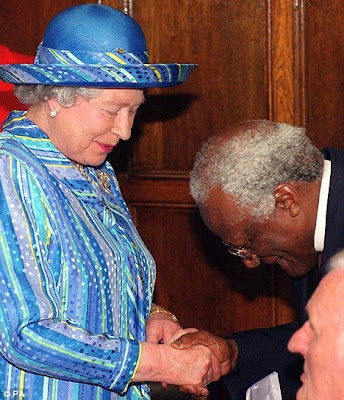 20th century icons: Archbishop Tutu with Queen Elizabeth in 1999
 Family men: David Beckham with the Archbishop in South Africa during the World Cup earlier this month
Former South African president Nelson Mandela made a similar decision to largely retire from public life back in 2004.
Tutu said once he steps down, he will no longer be available for media interviews and new appointments will not be added to his schedule.
He said, though, that he would stay involved with the Nobel Laureate Group and a group of international statesmen and women brought together by Mandela known as the Elders.
Tutu also will remained involved in the Desmond Tutu Peace Center in Cape Town
ARCHBISHOP Desmond Tutu, a leading figure in South Africa's struggle against apartheid, is retiring from public life.
The 78-year-old Nobel Peace Prize winner who first dubbed South Africa the 'Rainbow Nation' and campaigned tirelessly for its democracy, said yesterday he wanted to spend more time with his children, grandchildren and wife of 55 years.
The news was greeted with sadness and resignation in South Africa where the 5ft 5in priest, instantly recognisable in his flowing claret gowns, has a unique ability to unite the population in the face of deep racial divisions.


He said the time had come for him to 'slow down' and 'sip rooibos tea with my beloved wife in the afternoons, to watch cricket and to travel to visit my children and grandchildren rather than to conferences, conventions and university campuses'.
He will begin scaling down his activities following his 79th birthday in October.
More...Nelson Mandela's daughter and grandchildren held up at gunpoint after former leader's 92nd birthday party
Pressure on his time has been even greater since Nelson Mandela's withdrawal from public life six years ago. The two iconic men have homes in the same street in the township of Soweto. Yesterday's announcement cast a shadow over the country, which is coming down from the high of hosting the World Cup.
The archbishop, a father of four, appeared on a number of occasions during the tournament and gave a rousing speech at the opening concert, shouting: 'I'm dreaming, I'm dreaming. It's so beautiful - wake me up!'
He was once referred to as 'that evil little bishop' by Zimbabwe's president, Robert Mugabe.
But Nelson Mandela said: 'Tutu's voice will always be the voice of the voiceless.


He received the Nobel Peace Prize in 1984, then used his new international stature to step up the campaign against apartheid.
Tutu led calls for punitive sanctions against South Africa, remaining one of the few strong voices inside the country while other activists were imprisoned or forced to operate abroad.
He was ever-present during the turbulent final years of apartheid and the ensuing transition to majority rule, praying and sermonizing after massacres and then heading the Truth and Reconciliation Commission.
For more than two years the panel listened to people testifying about torture, killings and other atrocities during the apartheid era.


Former South African president Nelson Mandela made a similar decision to largely retire from public life back in 2004.
Tutu said once he steps down, he will no longer be available for media interviews and new appointments will not be added to his schedule.
He said, though, that he would stay involved with the Nobel Laureate Group and a group of international statesmen and women brought together by Mandela known as the Elders.
Tutu also will remained involved in the Desmond Tutu Peace Center in Cape Town
Saudi man chains his son in the basement for six years because he is 'possessed by an evil female genie'
A Saudi man has been chained in a basement apartment for more than six years because his father believes he is possessed by an evil female genie.
'When he has fits he has convulsions and his entire body twists and his eyes become completely white,' said the father of the 29-year-old man who has been identified only as Turki.
'Then the voice of a woman can be heard coming from him.'
 Evil spirits: Turki, 29, lies chained on the bed in the basement apartment where he has been for six years after being 'possessed by a genie'
When Turki first began behaving bizarrely, his father took him to local Muslim clerics to recite the Koran over him.
'But most of them became scared when they heard the female voice telling them that she was a royal jinn (genie) and that no-one can exorcise her unless Turki dies,' his father said.
One cleric advised him to shackle his son’s arms and legs in chains and read the Koran to him.
DREAM OF A GENIE THAT IS MORE LIKE A NIGHTMARE
Most Westerners know the term genie from the tale of Aladdin and his magic lamp or the hit 1960s sitcom, I Dream of Jeannie.
But genies, or jinn, in Islamic theology can be much more sinister. Some are good, others bad.
They are believed to be normally invisible but have the ability to assume human or animal form and are often said to be motivated by jealousy or revenge.
'We did this. My son became quiet but is totally unaware of what is happening around him. He does not talk and is now unable to harm anyone,' Turki’s father told Arab News, an English language Saudi daily.
But genies, or jinn, in Islamic theology can be much more sinister. Some are good, others bad.
A Saudi family last year took a 'genie' to court, accusing it of theft and harassment.
The jinn was said to have terrified the children by throwing stones, stealing mobile phones and speaking in male and female voices.
Turki lives in a tiny, two-room basement apartment with his impoverished mother and her three other children in the holy city of Mecca. They survive on £150 a month from social security.
His parents divorced before he was 'possessed'.
Turki’s father claimed he himself was afflicted by a jinn at the age of nine and suffered for more than four decades until it was exorcised by a cleric.
'I used to see a woman who would at times appear very beautiful and at times extremely ugly,' he said.
On some occasions she was 'surrounded by fire' and on others appeared 'with animal limbs'.
A Saudi human rights activist and professor in Sharia (Islamic law) who visited Turki found him to be in a 'semi-coma'.
Muhammad Al-Suhali said Turki 'did not know what was going on around him. He could not eat, drink or use the toilet without the help of others'.
The professor added that when started to read some Koranic verses, Turki became furious and shook until he nearly fell out of his bed.
'When I stopped reciting, he became quiet again but was distant and unaware of what was happening,' Suhali told Arab News.
He praised Turki’s young wife for staying with him despite his frightening condition.
Suhali called on Saudi Ministry of Social Affairs to provide the family with better accommodation and to include Turki in its social security programme.
A Saudi man has been chained in a basement apartment for more than six years because his father believes he is possessed by an evil female genie.
'When he has fits he has convulsions and his entire body twists and his eyes become completely white,' said the father of the 29-year-old man who has been identified only as Turki.
'Then the voice of a woman can be heard coming from him.'

When Turki first began behaving bizarrely, his father took him to local Muslim clerics to recite the Koran over him.
'But most of them became scared when they heard the female voice telling them that she was a royal jinn (genie) and that no-one can exorcise her unless Turki dies,' his father said.
One cleric advised him to shackle his son’s arms and legs in chains and read the Koran to him.
DREAM OF A GENIE THAT IS MORE LIKE A NIGHTMARE
Most Westerners know the term genie from the tale of Aladdin and his magic lamp or the hit 1960s sitcom, I Dream of Jeannie.
But genies, or jinn, in Islamic theology can be much more sinister. Some are good, others bad.
They are believed to be normally invisible but have the ability to assume human or animal form and are often said to be motivated by jealousy or revenge.
'We did this. My son became quiet but is totally unaware of what is happening around him. He does not talk and is now unable to harm anyone,' Turki’s father told Arab News, an English language Saudi daily.
But genies, or jinn, in Islamic theology can be much more sinister. Some are good, others bad.
A Saudi family last year took a 'genie' to court, accusing it of theft and harassment.
The jinn was said to have terrified the children by throwing stones, stealing mobile phones and speaking in male and female voices.
Turki lives in a tiny, two-room basement apartment with his impoverished mother and her three other children in the holy city of Mecca. They survive on £150 a month from social security.
His parents divorced before he was 'possessed'.
Turki’s father claimed he himself was afflicted by a jinn at the age of nine and suffered for more than four decades until it was exorcised by a cleric.
'I used to see a woman who would at times appear very beautiful and at times extremely ugly,' he said.
On some occasions she was 'surrounded by fire' and on others appeared 'with animal limbs'.
A Saudi human rights activist and professor in Sharia (Islamic law) who visited Turki found him to be in a 'semi-coma'.
Muhammad Al-Suhali said Turki 'did not know what was going on around him. He could not eat, drink or use the toilet without the help of others'.
The professor added that when started to read some Koranic verses, Turki became furious and shook until he nearly fell out of his bed.
'When I stopped reciting, he became quiet again but was distant and unaware of what was happening,' Suhali told Arab News.
He praised Turki’s young wife for staying with him despite his frightening condition.
Suhali called on Saudi Ministry of Social Affairs to provide the family with better accommodation and to include Turki in its social security programme.
Two Muslim women marched out of swimming pool in French holiday village because they were wearing burkinis
 Two Muslim women wearing the specialised bathing suit have been banned from a public swimming pool in France
They jumped into the water wearing garments that covered their entire bodies, including veils over their heads.
The incident came ten days after French MPs voted to outlaw the burka in public places.
The new law, which brands the garment 'an insult to the country's values', means women will be fined or jailed for hiding their faces in public.
The women at the Rives des Corbieres holiday camp in Port Leucate, southern France, were told the rules stated only swimming costumes may be worn in the water.
They were asked to either change into conventional bikinis or one-piece costumes or leave the swimming pool.
Police were then called to the drama on Wednesday after the husband of one of the women threatened the pool's lifeguard with a bowling ball.
A holiday camp spokesman said: 'The husbands became very irate that their wives were not allowed to swim with their bodies covered, and one of them threatened violence.
'Police were called and he eventually backed down. The two Muslim couples left the pool area and no charges were brought.'
Regional government official Marie-Paule Bardeche said: 'This is an issue stemming from the holiday centre's own regulations.
'They state men and women must wear ordinary swimwear for hygiene reasons. Men are not even allowed to wear long shorts in the water.'
Last year a Muslim woman was banned from wearing a burkini at a public swimming pool also for hygiene reasons.
She later failed in her bid to sue the council in the Paris suburb for discrimination.
Police have this year also stopped and fined two women for wearing a burka while driving because the garb impaired their field of vision.
 Members of Afghan girls band Burka Band standing in front of the ruins of Kabul (file photo). The burka has a mesh mask that covers a woman's eyes so that every part of her is hidden
France has now become the second country in Europe after Belgium to outlaw Muslim veil that hides the face.
President Nicolas Sarkozy has already described the burka as a 'sign of debasement'.
His immigration minister Eric Besson called it 'a walking coffin'.
The law was passed with an almost total majority of 335 to one MPs in the Paris parliament last week.
It must now be rubber-stamped by the Senate in September and is expected to come into force by spring next year.
The law will create a new offence of 'incitement to cover the face for reasons of gender'.
It will state: 'No-one may wear in public places clothes that are aimed at hiding the face.'
Under the new rules, women who hide their faces and husbands who force them to do so will both face fines and jail terms.
Men can be fined up to £25,000 and jailed for a year for forcing their wives to wear a burka
.

Women will face a smaller fine of around £130 because they are 'often victims who are not given any choice', the law states.
Repeat offenders who persistently refused to pay their fines will be sent to prison.
If caught wearing a burka, a woman will not be 'unveiled' in the street but instead taken to a police station to be formally identified.
The law will also apply to Muslim tourists - including the thousands of wealthy Middle Eastern visitors to the French capital every year.
Penalties will not be imposed until the law has been in operation for six months, to allow burka-wearers to adapt to the ban.
The new law comes comes after a year of heated debate on burkas and niqabs that is growing in Europe, and mounting public tensions over the issue.
There is also widespread support for a similar ban in the Netherlands, while Switzerland recently voted to ban the construction of new minarets on mosques.
Spain recently rejected a ban on the burka, and there are calls for a similar ban in Britain.
France has already banned wearing any relgious garb such as veils, Jewish skullcaps and crucifixes in schools.
Only around 5,000 women among France's five million strong population, the largest in Europe, wear full Muslim face veils in public.
But despite widespread support for a full ban, their highest legal body the Council of State has warned any legislation could be overturned by European human rights laws.
A French Council of State spokesman said in March: 'There appears to be no legally unchallengeable justification for carrying out such a ban.'
Left-wing politicians across Europe have also warned that a law banning the burka could inflame tensions in Muslim communities.
And human rights group Amnesty International has voiced its strong opposition to countries banning the burka.
The organisation's Interim Secretary General Claudio Cordone said: 'A general ban on the wearing of full-face veils would violate the rights to freedom of expression and religion of those women who choose to express their identity or beliefs in this way.'
Al Qaeda terrorists have also vowed revenge on France if it banned the burka on its streets.
Leaders of Al Qaeda's North African network wrote on an Islamic extremist website: 'We will seek dreadful revenge on France by all means at our disposal, for the honour of our daughters and sisters.'
 Two Muslim women wearing the specialised bathing suit have been banned from a public swimming pool in France
 Two Muslim women were ordered out of a swimming pool in France because they were wearing 'burkinis'.
The incident came ten days after French MPs voted to outlaw the burka in public places.
The new law, which brands the garment 'an insult to the country's values', means women will be fined or jailed for hiding their faces in public.
The women at the Rives des Corbieres holiday camp in Port Leucate, southern France, were told the rules stated only swimming costumes may be worn in the water.
They were asked to either change into conventional bikinis or one-piece costumes or leave the swimming pool.
Police were then called to the drama on Wednesday after the husband of one of the women threatened the pool's lifeguard with a bowling ball.
A holiday camp spokesman said: 'The husbands became very irate that their wives were not allowed to swim with their bodies covered, and one of them threatened violence.
'Police were called and he eventually backed down. The two Muslim couples left the pool area and no charges were brought.'
Regional government official Marie-Paule Bardeche said: 'This is an issue stemming from the holiday centre's own regulations.
'They state men and women must wear ordinary swimwear for hygiene reasons. Men are not even allowed to wear long shorts in the water.'
Last year a Muslim woman was banned from wearing a burkini at a public swimming pool also for hygiene reasons.
She later failed in her bid to sue the council in the Paris suburb for discrimination.
Police have this year also stopped and fined two women for wearing a burka while driving because the garb impaired their field of vision.

France has now become the second country in Europe after Belgium to outlaw Muslim veil that hides the face.
President Nicolas Sarkozy has already described the burka as a 'sign of debasement'.
His immigration minister Eric Besson called it 'a walking coffin'.
The law was passed with an almost total majority of 335 to one MPs in the Paris parliament last week.
It must now be rubber-stamped by the Senate in September and is expected to come into force by spring next year.
The law will create a new offence of 'incitement to cover the face for reasons of gender'.
It will state: 'No-one may wear in public places clothes that are aimed at hiding the face.'
Under the new rules, women who hide their faces and husbands who force them to do so will both face fines and jail terms.
Men can be fined up to £25,000 and jailed for a year for forcing their wives to wear a burka
.

A Muslim woman wearing the niqab (file photo) which, unlike the burka, leaves the eyes exposed
Women will face a smaller fine of around £130 because they are 'often victims who are not given any choice', the law states.
Repeat offenders who persistently refused to pay their fines will be sent to prison.
If caught wearing a burka, a woman will not be 'unveiled' in the street but instead taken to a police station to be formally identified.
The law will also apply to Muslim tourists - including the thousands of wealthy Middle Eastern visitors to the French capital every year.
Penalties will not be imposed until the law has been in operation for six months, to allow burka-wearers to adapt to the ban.
The new law comes comes after a year of heated debate on burkas and niqabs that is growing in Europe, and mounting public tensions over the issue.
There is also widespread support for a similar ban in the Netherlands, while Switzerland recently voted to ban the construction of new minarets on mosques.
Spain recently rejected a ban on the burka, and there are calls for a similar ban in Britain.
France has already banned wearing any relgious garb such as veils, Jewish skullcaps and crucifixes in schools.
Only around 5,000 women among France's five million strong population, the largest in Europe, wear full Muslim face veils in public.
But despite widespread support for a full ban, their highest legal body the Council of State has warned any legislation could be overturned by European human rights laws.
A French Council of State spokesman said in March: 'There appears to be no legally unchallengeable justification for carrying out such a ban.'
Left-wing politicians across Europe have also warned that a law banning the burka could inflame tensions in Muslim communities.
And human rights group Amnesty International has voiced its strong opposition to countries banning the burka.
The organisation's Interim Secretary General Claudio Cordone said: 'A general ban on the wearing of full-face veils would violate the rights to freedom of expression and religion of those women who choose to express their identity or beliefs in this way.'
Al Qaeda terrorists have also vowed revenge on France if it banned the burka on its streets.
Leaders of Al Qaeda's North African network wrote on an Islamic extremist website: 'We will seek dreadful revenge on France by all means at our disposal, for the honour of our daughters and sisters.'
Cameron's historic blunder: Fury as PM says we were 'junior partner' to Americans in 1940
David Cameron faced a furious backlash yesterday for the astonishing claim that the UK was a 'junior partner' to America in 1940 - a year before the U.S. even entered the war.
The Prime Minister was accused of forgetting the sacrifices made in 1940 by those who fought in the Battle of Britain, the heroes of Dunkirk and the Londoners bombed out of their homes in the Blitz.
Downing Street hastily claimed that Mr Cameron had meant to refer to the 1940s in general. But by then the damage was done.
General Sir Patrick Cordingley, former commander of the Desert Rats, said: 'I am quite sure if Winston Churchill were alive today he would be dismayed.'
 Snack time: David Cameron and New York City Mayor Michael Bloomberg stop for a snack
 Boost: The Mayor had his with mustard but the Prime Minister stuck to a plain hotdog
 Time out: The pair stopped off at the stand outside Penn Station after Mr Cameron arrived from Washington
Mr Cameron, on his first visit to the U.S. as Prime Minister, made his gaffe in an interview with Sky News.
'I think it's important in life to speak as it is, and the fact is that we are a very effective partner of the U.S., but we are the junior partner,' he said. 'We were the junior partner in 1940 when we were fighting the Nazis.'
More...Sam will let me off nappy duty this time, David Cameron tells U.S. television
STEPHEN GLOVER: I don't know which is worse: His ignorance of history or talking Britain down
Your country needs you: Cameron launches summer camp citizenship service for teenagers
In fact, Britain under the leadership of Churchill - one of Mr Cameron's heroes - stood alone in 1940 against Nazi Germany and had far more men under arms than the U.S. until 1944.
While Britain fought on, with some material assistance from the U.S., America did not actually enter the war until December 1941 after the Japanese bombing of Pearl Harbor.
And Britain lost a total of 449,800 war dead compared with 418,500 Americans.
Even as Downing Street was trying to repair the damage, the PM's error was compounded in a further interview, recorded earlier, with the American network ABC news.
He said: 'We were the junior partner in 1940 when we were fighting against Hitler; we are the junior partner now. I think you shouldn't pretend to be something you're not.'
 Onto the economy: Mr Cameron with H. Furlong Baldwin and Bruce E. Aust from Nasdaq
 Hello New York: The Prime Minister leaving the Nasdaq headquarters after meeting chief executives
Historian Andrew Roberts, author of the recent Second World War history The Storm of War, said: 'The Prime Minister is wrong. He shouldn't wear a hair shirt.
'In the early years of the war Britain had an army of 2.4million men in the field when the Americans had 240,000 - one tenth of the fighting force.
TODAY'S POLL
Is Britain the junior partner in its relationship with the U.S.?
Yes No VOTE POLL RESULTS
poll results 'It was not really until 1944 that the Americans had more men in the field than the UK, the British Empire and Commonwealth.
'In 1940 there was material help from America, but not belligerency against the Nazis. Britain was the dominant partner in terms of the strategy until at least 1943.'
Labour was quick to leap on Mr Cameron's mistake.
Former defence minister Kevan Jones told the Mail: 'David Cameron is guilty of talking down Britain and disrespecting Second World War veterans who know that Britain was fighting alone against Nazi tyranny while America was still putting its fighting boots on.'
 Hectic: David Cameron with U.N. Secretary-General Ban Ki-moon at the United Nations headquarters
As hostile reaction swept the internet, Mr Cameron's gaffe was greeted with dismay by retired military men.
SAS hero Andy McNab said: 'It's very important to get this history right because people are still living who fought in 1940. There are still survivors of Dunkirk and fighter pilots from the Battle of Britain. For them it is very, very important to recognise the role they played. This is living history.'
General Cordingley said: ' Having just spent the day with some Normandy veterans, I'm surprised that the Prime Minister has forgotten the sacrifice of those who fought in the Battle of Britain and North Africa before the U.S. entered the war and those who were bombed during the Blitz.'
General Sir Mike Jackson, a former head of the Army, said: 'The Prime Minister's history is not as good as it should be. Without doubt we were the superior partner until America's entry into the war. I'm sure the Prime Minister's jet lag is catching up with him.'

CORRELLI BARNETT: BRITAIN BORE THE BRUNT
 David Cameron's not just a travesty of the truth but also an insult to the memory of all those Britons who fought so heroically in the dark months of 1940, when this country stood alone against the Reich's tyranny.
Contrary to his absurd claim, there was no partnership whatsoever between the U.S. and Britain in that year. indeed, America was not involved in the war at all, either militarily or in supplying material support.
Despite the U.S.'s colossal resources and tradition of liberty, the republic did little to aid Britain's cause against the Nazis. Under the American Neutrality Act, it was actually illegal for the U.S. to ship any goods to a combatant unless cash was paid on strictly commercial terms.
Therefore, in the summer of 1940, Churchill's government had to pay up front for all the military equipment and aircraft it bought from the U.S., almost bankrupting itself by early 1941.
Nor was the U.S. remotely supportive during the Battle of Britain.
 Battle of Britain: Spitfire pilots who valiantly fought to save Britain from destruction run to their aircraft
Remarkably, heroic young Americans who wanted to volunteer for the RAF were warned that they could lose their U.S. citizenship and even be fined if they took part in the fighting, an edict that many of them thankfully ignored.
This reluctance to help Britain reflected the mood of anxious isolationism which gripped America in 1940.
Part of this stemmed from hostility to the old colonial power, part from the belief that conflicts in Europe were nothing to do with the New World.
It was an outlook that could be found right across Congress and the American public.
Even the U.S. ambassador to London, the roguish Joe Kennedy, father of the future President JFK, shared this mentality. In a typically defeatist outburst, Kennedy said in 1940 that 'democracy is finished in England'.
Franklin D Roosevelt himself, though personally much more eager to back Britain, was constrained by these attitudes.
Churchill fought a constant battle against this spirit of separatism.
One of the reasons that he took the notorious action in blowing up the French fleet in July 1940, after France had signed an armistice with Germany, was to impress Americans about Britain's determination to carry on the fight.
He also hoped that the defiance of the RAF against the Luftwaffe would change attitudes. But still the U.S. did not bend.
The dogma of isolationism was ended only when the Japanese attacked Pearl Harbor on December, 1941, 'a day that will live in infamy', to quote the words of Roosevelt.
It is no exaggeration to say that America might never have entered the war but for that fateful action.
For the first two years after Pearl Harbor, Britain and America could be described as 'equal partners'.
America might have had more military muscle, but Britain had all the experience of fighting.
At the vital planning conferences during 1942 and 1943, it was Churchill rather than Roosevelt who set the military strategy.
In particular, he saved America from the folly of launching an invasion of France in 1943, which could have only ended in disaster because the Allies were insufficiently prepared and Germany remained too strong.
Far more sensible was Churchill's plan for wiping out the Axis forces in North Africa and Italy.
It was not until D-Day was reached in June 1944 that Britain could be regarded as the junior partner, if only because of the colossal weight of the U.S. forces in Europe.
But D-Day could never have been happened if Britain had not fought so bravely four years earlier, when she alone withstood the might of the all-conquering Nazi war machine.
David Cameron faced a furious backlash yesterday for the astonishing claim that the UK was a 'junior partner' to America in 1940 - a year before the U.S. even entered the war.
The Prime Minister was accused of forgetting the sacrifices made in 1940 by those who fought in the Battle of Britain, the heroes of Dunkirk and the Londoners bombed out of their homes in the Blitz.
Downing Street hastily claimed that Mr Cameron had meant to refer to the 1940s in general. But by then the damage was done.
General Sir Patrick Cordingley, former commander of the Desert Rats, said: 'I am quite sure if Winston Churchill were alive today he would be dismayed.'


Mr Cameron, on his first visit to the U.S. as Prime Minister, made his gaffe in an interview with Sky News.
'I think it's important in life to speak as it is, and the fact is that we are a very effective partner of the U.S., but we are the junior partner,' he said. 'We were the junior partner in 1940 when we were fighting the Nazis.'
More...Sam will let me off nappy duty this time, David Cameron tells U.S. television
STEPHEN GLOVER: I don't know which is worse: His ignorance of history or talking Britain down
Your country needs you: Cameron launches summer camp citizenship service for teenagers
In fact, Britain under the leadership of Churchill - one of Mr Cameron's heroes - stood alone in 1940 against Nazi Germany and had far more men under arms than the U.S. until 1944.
While Britain fought on, with some material assistance from the U.S., America did not actually enter the war until December 1941 after the Japanese bombing of Pearl Harbor.
And Britain lost a total of 449,800 war dead compared with 418,500 Americans.
Even as Downing Street was trying to repair the damage, the PM's error was compounded in a further interview, recorded earlier, with the American network ABC news.
He said: 'We were the junior partner in 1940 when we were fighting against Hitler; we are the junior partner now. I think you shouldn't pretend to be something you're not.'


Historian Andrew Roberts, author of the recent Second World War history The Storm of War, said: 'The Prime Minister is wrong. He shouldn't wear a hair shirt.
'In the early years of the war Britain had an army of 2.4million men in the field when the Americans had 240,000 - one tenth of the fighting force.
TODAY'S POLL
Is Britain the junior partner in its relationship with the U.S.?
Yes No VOTE POLL RESULTS
poll results 'It was not really until 1944 that the Americans had more men in the field than the UK, the British Empire and Commonwealth.
'In 1940 there was material help from America, but not belligerency against the Nazis. Britain was the dominant partner in terms of the strategy until at least 1943.'
Labour was quick to leap on Mr Cameron's mistake.
Former defence minister Kevan Jones told the Mail: 'David Cameron is guilty of talking down Britain and disrespecting Second World War veterans who know that Britain was fighting alone against Nazi tyranny while America was still putting its fighting boots on.'

As hostile reaction swept the internet, Mr Cameron's gaffe was greeted with dismay by retired military men.
SAS hero Andy McNab said: 'It's very important to get this history right because people are still living who fought in 1940. There are still survivors of Dunkirk and fighter pilots from the Battle of Britain. For them it is very, very important to recognise the role they played. This is living history.'
General Cordingley said: ' Having just spent the day with some Normandy veterans, I'm surprised that the Prime Minister has forgotten the sacrifice of those who fought in the Battle of Britain and North Africa before the U.S. entered the war and those who were bombed during the Blitz.'
General Sir Mike Jackson, a former head of the Army, said: 'The Prime Minister's history is not as good as it should be. Without doubt we were the superior partner until America's entry into the war. I'm sure the Prime Minister's jet lag is catching up with him.'

CORRELLI BARNETT: BRITAIN BORE THE BRUNT
 David Cameron's not just a travesty of the truth but also an insult to the memory of all those Britons who fought so heroically in the dark months of 1940, when this country stood alone against the Reich's tyranny.
 Contrary to his absurd claim, there was no partnership whatsoever between the U.S. and Britain in that year. indeed, America was not involved in the war at all, either militarily or in supplying material support.
Despite the U.S.'s colossal resources and tradition of liberty, the republic did little to aid Britain's cause against the Nazis. Under the American Neutrality Act, it was actually illegal for the U.S. to ship any goods to a combatant unless cash was paid on strictly commercial terms.
Therefore, in the summer of 1940, Churchill's government had to pay up front for all the military equipment and aircraft it bought from the U.S., almost bankrupting itself by early 1941.
Nor was the U.S. remotely supportive during the Battle of Britain.

Remarkably, heroic young Americans who wanted to volunteer for the RAF were warned that they could lose their U.S. citizenship and even be fined if they took part in the fighting, an edict that many of them thankfully ignored.
This reluctance to help Britain reflected the mood of anxious isolationism which gripped America in 1940.
Part of this stemmed from hostility to the old colonial power, part from the belief that conflicts in Europe were nothing to do with the New World.
It was an outlook that could be found right across Congress and the American public.
Even the U.S. ambassador to London, the roguish Joe Kennedy, father of the future President JFK, shared this mentality. In a typically defeatist outburst, Kennedy said in 1940 that 'democracy is finished in England'.
Franklin D Roosevelt himself, though personally much more eager to back Britain, was constrained by these attitudes.
Churchill fought a constant battle against this spirit of separatism.
One of the reasons that he took the notorious action in blowing up the French fleet in July 1940, after France had signed an armistice with Germany, was to impress Americans about Britain's determination to carry on the fight.
He also hoped that the defiance of the RAF against the Luftwaffe would change attitudes. But still the U.S. did not bend.
The dogma of isolationism was ended only when the Japanese attacked Pearl Harbor on December, 1941, 'a day that will live in infamy', to quote the words of Roosevelt.
It is no exaggeration to say that America might never have entered the war but for that fateful action.
For the first two years after Pearl Harbor, Britain and America could be described as 'equal partners'.
America might have had more military muscle, but Britain had all the experience of fighting.
At the vital planning conferences during 1942 and 1943, it was Churchill rather than Roosevelt who set the military strategy.
In particular, he saved America from the folly of launching an invasion of France in 1943, which could have only ended in disaster because the Allies were insufficiently prepared and Germany remained too strong.
Far more sensible was Churchill's plan for wiping out the Axis forces in North Africa and Italy.
It was not until D-Day was reached in June 1944 that Britain could be regarded as the junior partner, if only because of the colossal weight of the U.S. forces in Europe.
But D-Day could never have been happened if Britain had not fought so bravely four years earlier, when she alone withstood the might of the all-conquering Nazi war machine.
Nelson Mandela's daughter and grandchildren held up at gunpoint after former leader's 92nd birthday party
Nelson Mandela's daughter and grandchildren were held up by gunmen after returning from the former South African president’s 92nd birthday party, it emerged today.
Mr Mandela’s daughter, Zindzi Mandela, and her children were attacked by two men as they arrived by car in the driveway of their home in Johannesburg.
They were ordered to lie down, but then the men decided to leave.
 Victim: Nelson Mandela's daughter Zindzi Mandela (left) and her children were attacked just hours after this photo was taken at his 92nd birthday party
However, they returned and searched the group, but then one of the men suddenly fired a shot. The victims' driver returned fire and the men, both said to be black, fled.
No one was hurt in the exchange on Sunday.
It is unknown whether the attackers hesitated because they recognised Miss Mandela, 49.
More...'I want to drink tea with my wife': Rainbow nation's anti-Apartheid icon Desmond Tutu to retire from public life aged 79
The family is still coming to terms with the death of Zindzi's grandchild Zenani, who died in a car crash ahead of the World Cup, hosted in South Africa in June.
Mourning for her death led Nelson Mandela to cancel his appearance at the opening ceremony.
Police said Mr Mandela's grandchildren were returning to their Johannesburg home from Mr Mandela’s estate across the city at 6.30pm on Sunday when the attack took place.
 Frail: Mr Mandela was confined to his chair as candles were lit on his cake
 Best wishes: Mr Mandela cuts his cake while family members look on
Gauteng police spokesman Brigadier Govindsamy Mariemuthoo said: ‘The driver was taking the children (home) and as they were getting into the gates
‘As they entered the yard and were getting out of the car, suddenly two armed black males approached them. They ordered them to lie down,’ he said.
‘One suspect fired a shot and the driver returned fire. They then fled the scene,’ he said.
A car with bullet holes in it and fitting the description of the one used by the attackers was later recovered.
Nelson Mandela's daughter and grandchildren were held up by gunmen after returning from the former South African president’s 92nd birthday party, it emerged today.
Mr Mandela’s daughter, Zindzi Mandela, and her children were attacked by two men as they arrived by car in the driveway of their home in Johannesburg.
They were ordered to lie down, but then the men decided to leave.

However, they returned and searched the group, but then one of the men suddenly fired a shot. The victims' driver returned fire and the men, both said to be black, fled.
No one was hurt in the exchange on Sunday.
It is unknown whether the attackers hesitated because they recognised Miss Mandela, 49.
More...'I want to drink tea with my wife': Rainbow nation's anti-Apartheid icon Desmond Tutu to retire from public life aged 79
The family is still coming to terms with the death of Zindzi's grandchild Zenani, who died in a car crash ahead of the World Cup, hosted in South Africa in June.
Mourning for her death led Nelson Mandela to cancel his appearance at the opening ceremony.
Police said Mr Mandela's grandchildren were returning to their Johannesburg home from Mr Mandela’s estate across the city at 6.30pm on Sunday when the attack took place.


Gauteng police spokesman Brigadier Govindsamy Mariemuthoo said: ‘The driver was taking the children (home) and as they were getting into the gates
‘As they entered the yard and were getting out of the car, suddenly two armed black males approached them. They ordered them to lie down,’ he said.
‘One suspect fired a shot and the driver returned fire. They then fled the scene,’ he said.
A car with bullet holes in it and fitting the description of the one used by the attackers was later recovered.